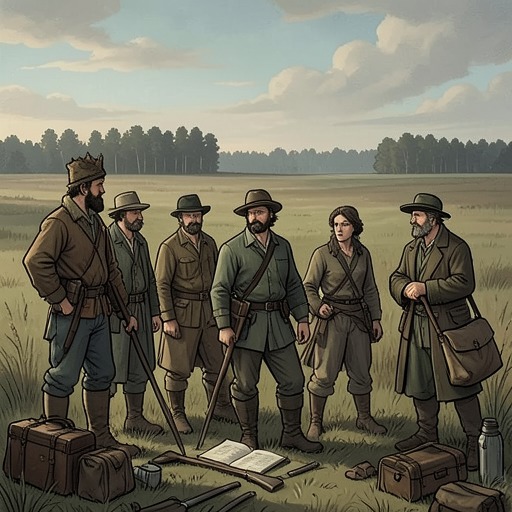
Toxin Grain Crisis and the Expulsion of Ahmed Fadel Omar
The Deer KingThe toxic-grain crisis and the expulsion of the Ahfal Oma are recalled as a disaster whose causes remain contested but whose human consequences endure. A hybrid crop killed horses and sheep; the resulting conflict led to the burning of a village and the Ahfal Oma’s exile. Later testimony complicates the accusation that immigrant rye alone caused the deaths, while Hohsalle’s effort to investigate the first cases of mittsual shows how the old catastrophe remains entangled with new questions of disease and blame.
Causes and Contested Accounts
The crisis enters the story through Hohsalle’s questions about past livestock losses. An old woman, Nohmeh, remembers sheep dying after bites, tick exposure, and toxic grain, and recalls the widespread belief that her people had made a mistake in coming to the region. Tomeh adds that the Ahfal Oma’s horses died in a major uproar and that one village was burned. Hohsalle identifies the conflict as the Ahfal Oma’s revenge and reports the familiar account: the horses had eaten rye brought by the settlers.
Nohmeh angrily rejects that explanation. She insists that the horses ate red wheat grown by the Ahfal Oma themselves, not grain supplied by her people. Taya, her companion, explains a more complicated agricultural cause: the Ahfal Oma cultivated native Aquafa wheat, but it had apparently crossbred with rye pollen carried on the wind. The hybrid grain was more likely to be toxic, and its poison was powerful. The crop’s origins thus crossed the boundaries around which blame had been organized: the dangerous grain grew in Ahfal Oma fields, but its hybridization was linked to rye introduced by settlers.
Livestock Loss and Retaliation
The hybrid grain harmed both communities’ livelihoods. Taya says that the Ahfal Oma’s fire horses died after eating it, while many settlers’ sheep also perished. The sheep developed what the settlers called sheep-dancing sickness: they leapt and convulsed before dying. The evidence does not settle every detail of the horses’ exposure, but it establishes that grain toxicity affected animals on both sides of the conflict.
A separate recollection from Tomasolle connects poisoned rye, animal illness, and an older practice involving dogs. Shikan recounts a song in which a dog eats the flesh of a horse buried in Kinma’s mound, bears pups, and dies; those pups grow into strong village hounds. He explains that people had buried horses that died of illness and later fed their carcasses to pregnant dogs, whose pups were believed to become loyal and resistant to sickness. Tomasolle says the Ahfal Oma also buried horses after they died from eating poisoned rye and fed them to pregnant dogs. But he rejects this practice as the explanation for mittsual’s spread: the dogs did not bear pups, and he personally confirmed that they suffered and died. Since the first known mittsual case occurred nearby, he asks permission to investigate whether the poisoning could nevertheless be related. Cheehana agrees that the question needs further study but objects to Tomasolle leading it because of his closeness to the Ahfal Oma.
Exile and Its Costs
After the Ahfal Oma were exiled, the settlers spent a long time burning off the Aquafa wheat before they could grow rye safely. That remedy marks a lasting change to local agriculture, but it does not undo the earlier losses or the political violence. The account establishes that a village was burned and that the Ahfal Oma were driven out; it does not present a settled, neutral verdict on responsibility. Instead, the conflicting memories preserve how agricultural harm became a grievance between communities.
The wider settlement policy gives that grievance an imperial context. Hohsalle explains that frontier settlers were poor farmers and herders from the edges of the Zolian realm, ordered to move whenever conquest expanded the borders. They were expected to establish Zolian-style communities, grow the crops and raise the livestock preferred by Zolians, and mingle with conquered peoples until the territory became Zolian. In return, their taxes were lower than at home and cleared farmland belonged to them. Yet the privileges did not cancel the loss of home: settlers could be unable to return to their native land, while local people faced the conversion of their territory and ways of life. The account places the conflict within a policy that used settlers to transform conquered regions, rather than treating it as an isolated quarrel over grain.
Recollection, Disease, and Blame
The crisis resurfaces during an investigation of mittsual, so the historical dispute is not merely background. Tomasolle distinguishes what he knows from what he suspects: the dogs did not produce surviving pups, the first case occurred near the poisoned-grain episode, and a connection cannot be ruled out. His request is for further inquiry, not a declaration that grain caused the disease. Cheehana’s concern about his personal ties shows that investigating the past also raises questions about trust and impartiality.
Nohmeh’s fierce denial is made more intelligible when Hohsalle explains her circumstances. She was among immigrants forced to leave her homeland and spend her life in a place she did not choose, where local people hated her community and hardship repeatedly followed. Her testimony does not resolve the grain dispute; it reveals what accusation means to someone who has already borne displacement. Across the competing accounts, toxic crops, livestock losses, retaliation, and exile remain linked, while the exact route from that earlier disaster to mittsual remains open to investigation.